
Amazing Maize
If I asked you what grain is the most harvested in the world, you’d probably answer either wheat or rice. But the answer is actually corn, more accurately called ‘maize.’

This nutritious crop that originated in Mexico feeds not only people but also animals around the world. We’re used to the wonderfully tender sweet corn harvested in late summer and early autumn. But most maize is actually field corn, more starchy than sweet and used as animal feed or to make cornmeal, flour, hominy, polenta, and grits.
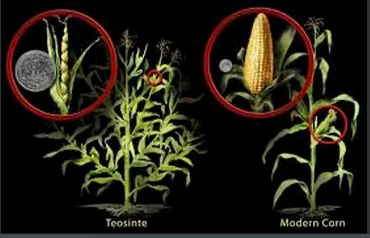
For a long time, biologists puzzled about the origins of this important crop. There is no wild plant that looks anything like modern corn, which is actually a giant grass. The closest relative is a scrawny branching plant with hard dark seeds called teosinte. It seems a huge jump from teosinte to corn, yet geneticist George Beadle found in the 1930s that corn and teosinte have the same number of chromosomes and could be crossbred to produce hybrids. With the limited tools available at that time, Beadle deduced that only about five genes were involved in creating the differences between teosinte and corn.
Fast forward to modern times, when scientists can look directly at DNA and analyze every detail of its structure. We now know that Beadle came very close to the truth—about five regions in the DNA seem to control the major differences between teosinte and corn. For example, these two plants look so very different, yet just one single gene turns a branched plant into a single stalk, like a stalk of corn. Another single gene controls one of the most dramatic and certainly most important traits for farmers—the nature of the seeds and their stalk. In teosinte, each seed has a hard covering. Just one gene eliminates the hard covering and produces a stalk bearing exposed seeds, like an ear of corn.
Scientists now use maize as a perfect example of two major ways evolution happens. One way is through major sudden jumps, like the change from a branching plant to a single stalk. The other is the more gradual kind of change that has led to the thousands of different kinds of maize grown by farmers today. There are probably hundreds of varieties of sweet corn and thousands of varieties of field corn.
Think about that the next time you bite into a nice crunchy taco made from a corn tortilla.
I have never heard of teosinte before and was compelled to look up more information about it. It would be a fun little research project for my kids to see if they can develop a new variety of corn from teosinte. I know that in my garden one year I had gourds and zucchinis cross pollinate to grow a gourd shaped zucchini; it was very fascinating. I wonder how difficult it would be to see if you can develop your own new variety of corn this way.
On a side note: I also have a friend who makes her own hominy and says there is no comparison between homemade and the canned variety. Something else I need to try. I don't even know where I'd get field corn for human consumption around here.
An interesting little maize factoid: I took a Latin American Literature class (in Spanish). One of our topics was the Mayan holy book The Popol Vuh. A Dominican Friar translated it into Spanish in the 1700s. The excerpts we read included the topic of maize.